
Epoxy Self-Leveling Floor Coating: Complete Buyer's Guide
Solvent-free epoxy self-leveling floor coating explained: system build-up, mixing ratio, application sequence, common failures, and how to verify a Chinese test report. Specifier's guide from a CNAS-tested manufacturer.

A seamless epoxy floor is one of the few building products where the material and the workmanship are almost inseparable. The same drum of resin can produce a mirror-smooth floor that lasts fifteen years, or a blistered, peeling surface that fails inside a season. The difference is rarely the product — it is whether the system was specified correctly, whether the substrate was understood, and whether the applicator knew what "done properly" looks like.
This guide is written for the three people who decide that outcome.
If you are a contractor, you will find the application sequence and the failure modes that cost you money on rework.
If you are an importer or distributor, you will find what to verify before you put a Chinese epoxy brand in front of your own customers.
If you are a specifier, consultant or facility engineer, you will find how to read a Chinese test report properly — including what it does not tell you.
ZHENG'OU has manufactured resin flooring since 2002 and exports to more than thirty countries. Our laboratory operates under CNAS accreditation, and the data quoted in this article comes from reports we can put in front of you, not from a marketing deck.
Key takeaways
- Solvent-free does not mean zero VOC. Ours measures 18 g/L against a 60 g/L limit.
- "Self-leveling" describes flow behaviour, not the ability to correct an uneven slab.
- The mixing ratio is 5:1 by weight, and it is not a suggestion.
- A hazardous-substance report and a performance report are two different documents. Ask for both.
- Most failures are decided before the first bucket is opened.
1. What "Solvent-Free" Really Means — and What It Doesn't
In coating terminology, "solvent-free" describes what is absent from the formulation, not what is absent from the finished chemistry. A solvent-free epoxy contains no volatile solvent added to reduce viscosity or extend working time. The binder itself is fluid enough to be applied, and it converts almost entirely into the cured film rather than evaporating away.
That distinction separates three product families that are often confused in tender documents:
- Solvent-based epoxy — thin, fast-drying, cheap per litre, but the solvent must leave the film. Escape routes become pinholes, shrinkage stress, and odour. Films must stay thin or they trap solvent and fail.
- Waterborne epoxy — water is the carrier. Low odour, faster moisture tolerance in some systems, generally lower chemical and abrasion resistance than a true solvent-free system, and sensitive to cold and humidity during cure.
- Solvent-free epoxy — no carrier to evaporate. High film build in a single application without solvent entrapment, minimal shrinkage, low odour, and a dense, non-porous surface. This is the family used for pharmaceutical cleanrooms, food plants and heavy-duty industrial floors.
The practical consequences are what matter to a buyer. Because nothing has to evaporate, a solvent-free system can be built to a substantial thickness in one pour without the shrinkage cracking that plagues thick solvent-based films. Because there is no solvent smell, it can be applied in occupied buildings and in facilities where production resumes quickly. And because the film is dense, cleanability and chemical resistance are structurally better.
The part most suppliers avoid
Solvent-free is not zero VOC, and any supplier who tells you otherwise is either misinformed or hoping you will not check.
Our own solvent-free self-leveling topcoat measures 18 g/L of VOC, against a limit of 60 g/L for solvent-free floor coatings under GB 30981.1-2025. That 18 g/L is real, and it comes from small residual fractions — the alcohol content disclosed openly in Section 3 of our safety data sheets — not from an added thinner. We publish the number rather than claiming zero, because a specification manager who knows the chemistry will find the alcohol in the SDS anyway. Better that we explain it first.
Two further honest limits:
Solvent-free does not mean odourless. Low odour, yes. During application and through the early part of the cure there is a distinct amine character. Ventilation is still required.
Solvent-free does not mean forgiving. Because there is no solvent to escape, there is also no second chance: contamination, moisture and poor preparation show up in the finished floor instead of evaporating away.
Recommended reading: Solvent-free epoxy self-leveling topcoat →
2. How Self-Leveling Epoxy Forms a Seamless Floor
A two-component epoxy is a stoichiometric system. Part A carries the epoxy resin; Part B carries the curing agent, typically an amine. When they are combined, the amine opens the epoxide rings and the molecules cross-link into a three-dimensional thermoset network. The film does not dry by evaporation. It cures by chemical conversion, which is why it can be walked on without ever having "dried" in the conventional sense, and why it cannot be re-dissolved once fully cured.
Self-leveling depends on two properties working together: low viscosity and the absence of thixotropic structure. A self-leveling mix has nothing holding it in place, so surface tension pulls it flat. Pour it and it finds its own level.
This is where most misunderstandings begin. "Self-leveling" does not mean the floor corrects the slab. It means the material levels within its own poured depth. If the substrate undulates, the finished floor will undulate with it — faithfully, and with a glossy surface that makes every deviation more visible than it was before. Substrate flatness is a separate problem, solved by the midcoat, not by the topcoat.
The same logic applies to slope. A self-leveling floor follows the fall of the slab it is poured onto. If you need a fall to a drain, the fall has to exist in the substrate.
Why 5:1 by weight is not negotiable
Our published mixing ratio is A : B = 5 : 1 by weight, and it appears on our hazardous-substance test report as part of the tested product identity.
That ratio is the stoichiometric balance. Get it wrong and the network does not form completely:
- Too much Part B leaves unreacted amine. The surface cures with a greasy, waxy film — amine blush — that destroys intercoat adhesion unless removed. The film is harder but more brittle, and moisture sensitivity increases.
- Too much Part A leaves unreacted resin. The floor stays soft or tacky far longer than it should, and chemical resistance drops because the network is incomplete.
- Volume instead of weight is the most common silent error. The two components do not share a density, so measuring by volume gives a different ratio than measuring by weight.
A supplier that supplies the two components as a matched set — one Part A to one Part B, in the correct proportion — removes this entire failure mode from your site. That is a logistics decision we make deliberately.
3. The Three-Layer Build-Up — and Why Each Layer Exists
A solvent-free self-leveling floor is a system, not a product. Three layers, three jobs, and each one can fail independently.
| Layer | Primary job | What it prevents | If it is missing or wrong |
|---|---|---|---|
| Primer | Wet out and seal the substrate; anchor the system | Outgassing from concrete; poor adhesion | Bubbles, pinholes, delamination |
| Midcoat | Build thickness; carry load; correct minor undulation | Point-load failure; telegraphing of slab defects | Crushing under racking, visible ridges, shortcut service life |
| Self-leveling topcoat | Wear surface, chemical resistance, cleanability, appearance | Abrasion, staining, porosity | Rapid wear, staining, difficult cleaning |
Primer — the layer that gets skipped and should not
Concrete is porous and, more importantly, it is full of air. When a solvent-free resin is poured onto untreated concrete, the air in the pores expands as the slab warms and escapes upward through the wet film. The result is a field of bubbles that appear to rise from below — because they do. A correctly specified primer penetrates and seals the surface, closing those escape routes and simultaneously providing the chemical bridge between concrete and epoxy.
The primer is also where moisture decisions are made. If the slab is reading high, no primer will fix it; the answer is a surface damp-proof membrane or a moisture-tolerant primer system chosen for that condition. This is a conversation to have before mobilisation, not after.
Recommended reading: Solvent-free epoxy primer →
Midcoat — where load capacity actually comes from
The topcoat is what you see. The midcoat is what carries the forklift. Thickness contributes to load-bearing capacity, and a midcoat can be built up with graded aggregate to create a mortar-like layer that spreads point loads across a wider area. That is the difference between a floor that survives steel racking feet and one that dents.
The midcoat is also the layer that corrects. Minor hollows, spalling patches and old surface irregularities can be filled here, so that the thin self-leveling topcoat has a fair surface to flow across. Trying to correct a bad slab with the topcoat is both expensive and unsuccessful.
Where a heavier build is needed for impact and abrasion, an aggregate-loaded variant is used instead of a plain self-leveling midcoat — a floating-sand system, in our range.
Recommended reading: Epoxy floating-sand self-leveling →
Topcoat — the self-leveling layer
The topcoat is the solvent-free self-leveling product itself: poured, spread, de-aired, and left to find its own level. This is where gloss, chemical resistance, cleanability and colour come from.
We deliberately do not publish a single "recommended thickness" for this product, because thickness is a design output, not a product property. A light-duty assembly area and a container-handling bay do not want the same build-up, and quoting one number for both would be a disservice to the buyer who actually reads the drawing set. What we publish is the logic: load class and substrate condition determine the system, and we will size it with you.
Recommended reading: Epoxy flooring systems →
4. Nine Questions Serious Buyers Ask — and How We Answer Them
Every experienced buyer asks the same nine things. Here is how we answer them, without hiding behind a brochure.
1. What is the mixing ratio, and do you supply the components as a matched set?
A : B = 5 : 1 by weight, stated on our test report. We supply the two components as a matched system so that the ratio is delivered by the packaging rather than calculated on site. Mixing errors are the single most common cause of soft, patchy or blushing floors, and it is a risk we can design out of the project rather than warn you about.
2. How long do I have to work with it, and when can I recoat?
Working time and recoat window both move with temperature, and a number quoted for a European spring is wrong for a Middle Eastern summer. We therefore issue the values for the specific system and the season of your shipment in the technical data sheet that accompanies the order, and our technical team confirms them for your site conditions before mobilisation.
3. What thickness and how many layers does my project need?
We size the system rather than publish one figure. Tell us the load class, the substrate condition, the service environment and the intended service life, and we will propose a build-up — normally two or three options at different levels of robustness — with the reasoning shown. On a drawing set this becomes a specification you can defend; on site it becomes a scope you can price.
4. What do you require of my substrate?
Four things, always: adequate mechanical strength, adequate flatness, controlled moisture, and cleanliness. How each is measured and what the acceptance values are belongs in the project documents, and we provide them for the specific system so that the contractor and the client are testing against the same criteria. Where the slab cannot meet them — rising moisture being the classic case — we will say so and propose the membrane solution instead of pouring over a problem.
5. At what temperature can it be applied?
The window is defined by the system, and it is governed by substrate temperature rather than air temperature. We state the range for your specific product and season, and we also state what happens outside it — slow cure, blush, or a film that never reaches full chemical resistance. This is one of the points our technical team confirms in writing before your applicator mobilises.
6. Can you provide mechanical performance reports?
Here we are specific. The hazardous-substance report for this product is available immediately, and we quote from it openly in this article. Mechanical performance testing for a specific product and batch is arranged on request, and we will tell you honestly which report covers which product — because in this industry it is common to quote a sister product's compressive strength and hope nobody checks the report number.
7. Which standard is the hazardous-substance report based on?
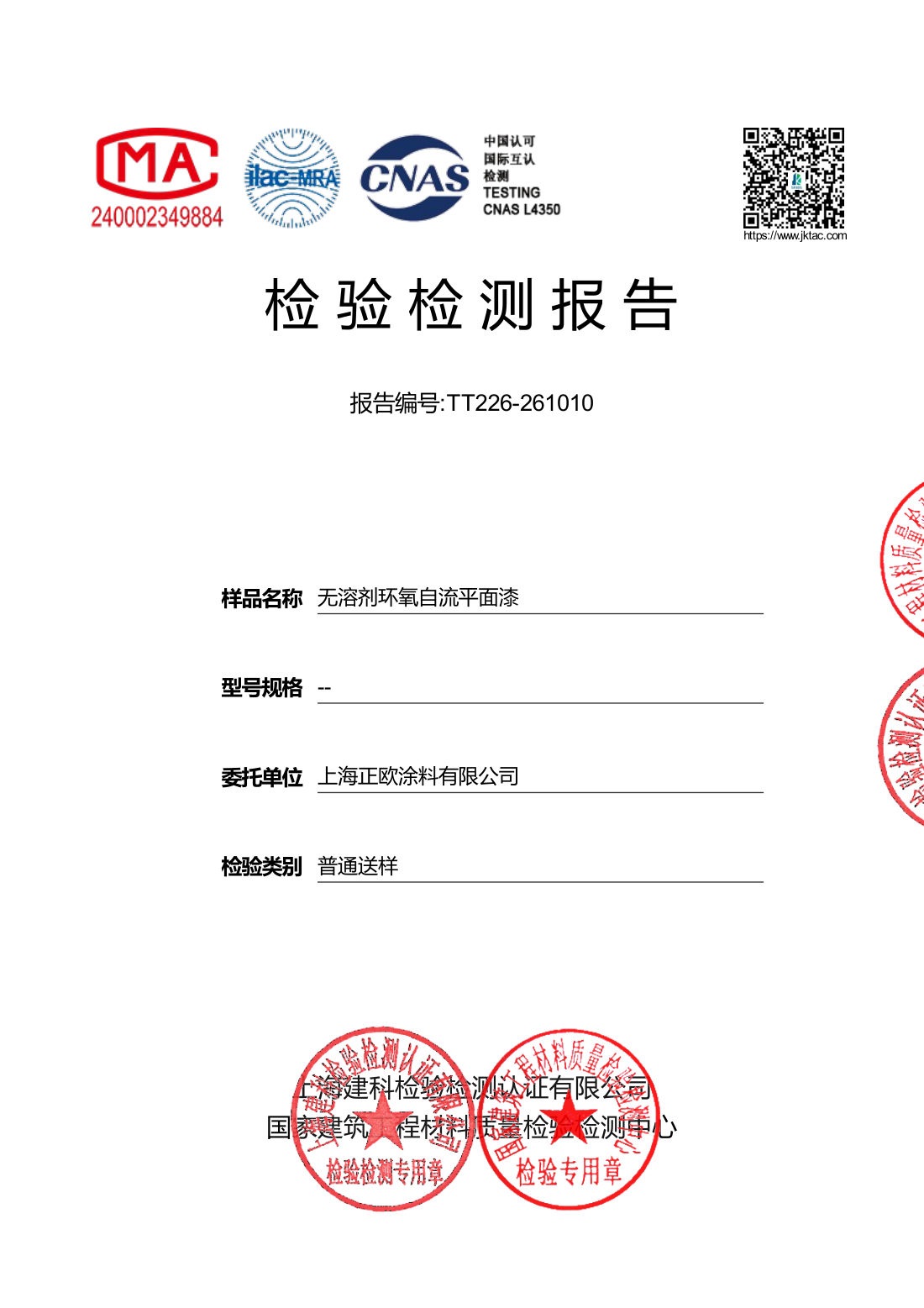
GB 30981.1-2025, Limit of harmful substances in coatings — Part 1: Architectural coatings, under the section for floor coatings, solvent-free type. Our report number is TT226-261010, issued by Shanghai Jianke Inspection and Testing Certification Co., Ltd. on 17 June 2026, under CNAS accreditation L4350 and CMA registration 240002349884.
8. What documents come with the shipment?
Technical data sheet, safety data sheet in export format, transport identification report, and a batch certificate. One detail worth knowing: the two components carry different UN numbers and different hazard classes — Part A under UN3082 (class 9) and Part B under UN2735 (class 8). That distinction affects booking, container stowage and port handling, and suppliers who have never actually exported often discover it at the worst possible moment. We plan for it in advance.
9. If something goes wrong, how is responsibility divided?
Material performance and application quality are separate obligations, and pretending otherwise helps nobody. Our position is simple: we are responsible for the material meeting its published specification and for the technical guidance we issue; the applicator is responsible for substrate preparation, mixing discipline and application conditions. Where a dispute arises, the first question is always which of those failed — and the answer is usually found in the substrate record, the batch record and photographs taken during the works. This is why we ask contractors to document preparation and mixing, and why we recommend the same to their clients.
5. What the Test Report Proves — and What It Doesn't
The report referenced throughout this article is TT226-261010, issued 17 June 2026 by Shanghai Jianke, for a solvent-free epoxy self-leveling topcoat, tested to GB 30981.1-2025 for solvent-free floor coatings.
| Parameter | Limit | Measured |
|---|---|---|
| VOC content | ≤ 60 g/L | 18 g/L |
| Free formaldehyde | — | Not detected |
| Glycol ethers | — | Not detected |
| Benzene | — | Not detected |
| Toluene + xylene | — | Not detected |
| Halogenated hydrocarbons | — | Not detected |
| Phthalates | — | Not detected |
| 4,4′-Methylenedianiline (MDA) | — | Not detected |
| Total lead | — | Not detected |
| Sum of polycyclic aromatic hydrocarbons | ≤ 500 mg/kg | 10.1 mg/kg |
What it proves
Three things, and they are worth stating plainly.
First, the product complies with the Chinese national limit for harmful substances in solvent-free floor coatings — tested by an accredited third-party laboratory, not self-declared.
Second, the low-VOC claim is verifiable. At 18 g/L against a 60 g/L limit, the margin is wide enough that it is not a rounding exercise.
Third, the "not detected" entries are not marketing language. They are instrument readings against defined detection limits, and they are the reason this product can be proposed for pharmaceutical, food and healthcare environments where emissions are reviewed.
What it does not prove
It does not prove compressive strength, abrasion resistance, adhesion, impact resistance, or service life. Those belong to a performance report against a different standard, and they are a separate document.
This is the most common misunderstanding we encounter in tender reviews, and it cuts both ways. A buyer who sees a clean hazardous-substance report may assume the mechanical performance has been verified — it has not. A buyer who sees a performance report with impressive numbers may assume the product is low-emission — it may not be.
Our position, and we would rather state it than have it discovered: for this product we can verify and publish the hazardous-substance data, and we do not publish mechanical figures we cannot attribute to this exact product. A supplier who volunteers that distinction is telling you something about how they handle the rest of their documentation too.
6. Where It Works — and Where It Fails
A solvent-free self-leveling system is the right answer in more environments than most products, and the wrong answer in a few. Both lists matter.
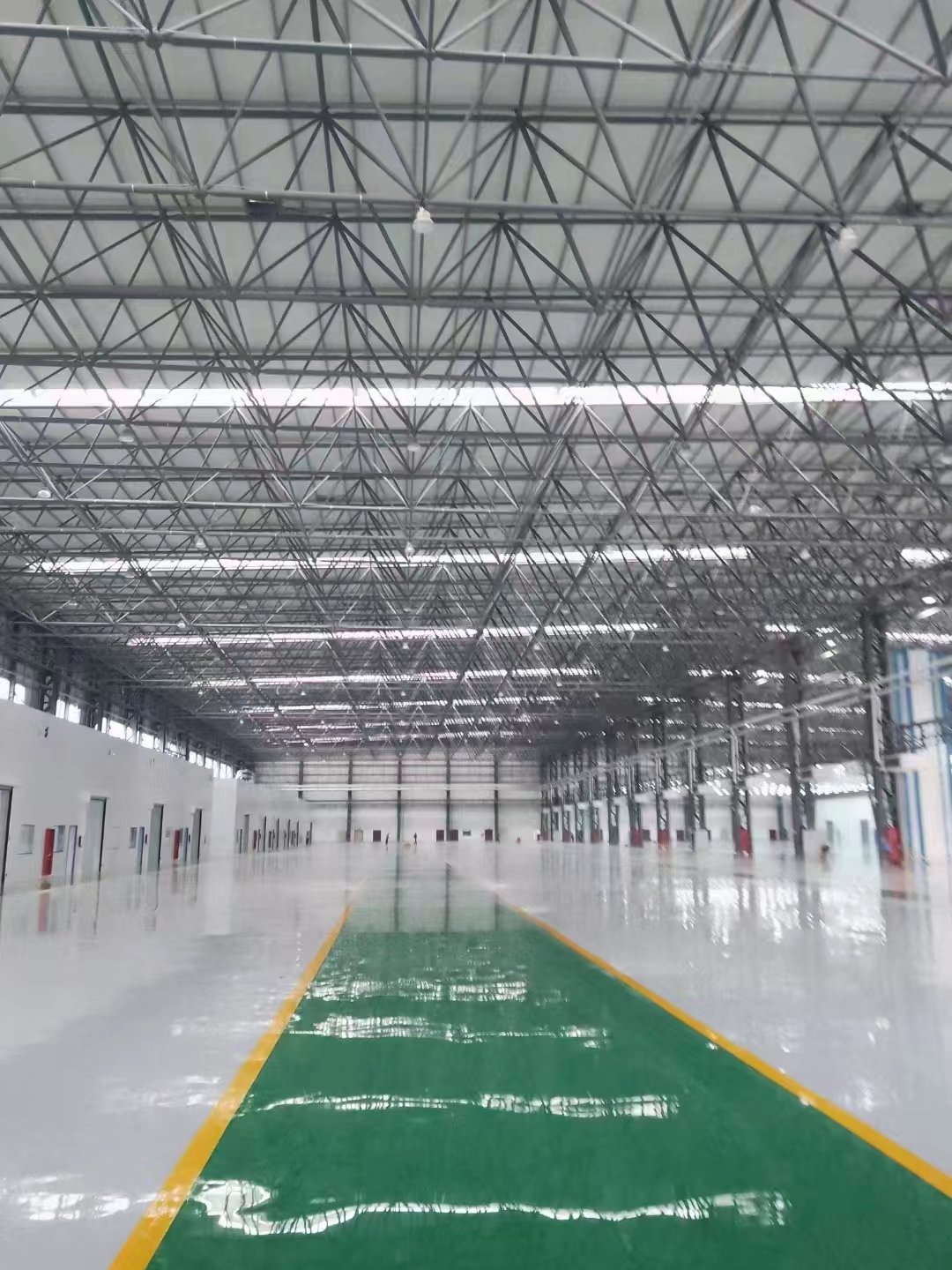
Electronics and microelectronics. Seamless, low-particle, easy to clean, and available in an antistatic variant where static discharge threatens components. The failure mode to design against is not wear but ESD performance drifting over the service life — specify the conductive system, not a standard floor with a conductive claim.
Pharmaceutical cleanrooms. No joints means no harbourage points, which is exactly what GMP cleaning validation wants to see. Gloss makes residue visible, which is an advantage during inspection and a disadvantage during construction — every defect shows.
→ Pharmaceutical and GMP flooring →
Food and beverage. Resists steam, organic acids, sugars and thermal shock from washdown, and the seamless surface supports HACCP cleaning regimes. Where hot fats or concentrated acids sit on the floor continuously, a higher-grade system is required — a standard self-leveling topcoat is not a chemical lining.
→ Food and beverage flooring →
Chemical and process plants. Handles splash, spill and intermittent contact with dilute acids, alkalis and oils. It is not a containment lining, and it should never be specified as one. Where continuous immersion or concentrated reagents are involved, the conversation changes completely.
→ Chemical-resistant flooring →
Cold chain and freezer rooms. The coating survives freeze-thaw cycling once cured; the challenge is curing it at low temperature in the first place. This is a scheduling and system-selection problem, and it is solvable — but only if it is raised before mobilisation rather than during.
→ Cold storage and logistics flooring →
Heavy manufacturing and workshops. Abrasion, impact, dropped tools, oil, coolant. Here the midcoat does the work, and a plain topcoat over a thin midcoat will fail at the racking feet long before the surface wears out.
Parking and vehicle areas. Tyre marks, oil, and traffic. Where daylight reaches the floor, note that epoxy is not UV-stable and will yellow — a polyurethane topcoat is the correct answer for exposed parking decks.
→ Garage and parking flooring →
Healthcare. Disinfectant resistance, rolling loads, seamless hygiene, and a surface that survives repeated cleaning without going dull or porous.
Commercial and retail. Colour, gloss and design intent. Perfectly workable, and a legitimate use — just be aware that a decorative floor in a retail space is judged on appearance, so substrate flatness matters more, not less.
Renovation over existing floors. Viable over sound existing coatings, provided adhesion is tested rather than assumed, and provided the existing coating is compatible. Where the old floor is failing, the failure has to be removed, not covered.
The four honest limitations
Exposed to sustained UV, an epoxy topcoat yellows. Outdoors, under skylights, or on open decks, use a polyurethane topcoat.
Standing water and immersion require a system designed for it. A self-leveling floor is a floor, not a tank lining.
Hot chemical spills, concentrated reagents and continuous process exposure exceed the design envelope.
Slabs with rising moisture need a membrane. No primer substitutes for one.
7. Application Sequence: Five Stages
For each stage, three questions: what is happening, what it costs you if it is skipped, and how to tell it was done properly.
Stage 1 — Substrate preparation
Mechanical preparation by shot blasting or diamond grinding, opening the surface profile so the primer has something to key into. Cracks are chased and filled; oil and contamination are removed, not painted over.
Skipped, it costs you: delamination, pinholes, and "picture framing" where the primer telegraphs the grinding pattern.
Done properly: the surface is uniformly matt, rough to the touch, dust-free, and the contractor can show you the preparation method and the areas that were repaired.
Stage 2 — Priming
The primer is worked into the substrate, not floated over it. On porous or open slabs a second application may be required, and on very absorbent concrete the primer can be cut back with a compatible thinner according to the technical data sheet.
Skipped, it costs you: outgassing bubbles rising through the topcoat, pinholes across the whole field, and weak adhesion at the most critical interface in the system.
Done properly: no dry, shiny patches where resin sat on the surface without penetrating; no ponding; the film is uniform.
Stage 3 — Mixing
Part A is agitated first, then Part B is added at the published ratio — 5:1 by weight. Mechanical mixing with a helical paddle, scraping the sides and bottom of the container so no unmixed material hides there, then transferring to a clean container. The clock starts at combination, not at pouring.
Skipped, it costs you: soft patches, amine blush, slow cure, colour variation between batches — and every one of those looks like a material defect even when it is a mixing defect.
Done properly: the applicator weighs the components, mixes for the full time, and does not mix more than can be placed within the working window.
Stage 4 — Pouring, spreading and de-airing
The mixed material is poured in a controlled line and spread with a serrated trowel or rake, then gone over with a spike roller to release entrapped air. Wet edges must be maintained; a "cold joint" where material from two mixes meets after the first has begun to gel will remain visible for the life of the floor.
Skipped, it costs you: visible seams, roller marks, bubble trails, and thickness variation that shows as shading under gloss.
Done properly: one continuous operation across a bay, a single crew with a rhythm, and a spike roller used behind the spreader rather than after the material has begun to set.
Stage 5 — Curing and handover
The floor is protected from traffic, water and dust until it has cured enough for the next operation. Note the distinction that catches people out: the floor can be hard enough to walk on long before it has reached full chemical resistance. Judging readiness with a fingernail is not a method.
Skipped, it costs you: footprints and tool marks that cannot be repaired invisibly, blushing from early water contact, and a floor handed over before it can take the loads it was specified for.
Done properly: the handover date follows the technical data sheet for your site temperature, and the client is told what the floor can and cannot be exposed to in the first period.
8. Eight Failures, Their Causes, and Prevention
Most epoxy floor failures are decided before the first bucket is opened. These are the eight we see most often, with the cause that is usually responsible.
| Failure | Appearance | Usual cause | Prevention |
|---|---|---|---|
| Bubbling | Blisters rising through the film, often in the warmest part of the slab | Air or moisture escaping from the concrete; primer missed or too thin | Correct primer, sealed surface, correct application temperature |
| Pinholes | Fine crater field across the whole surface | Air entrapped during mixing; primer absorbed unevenly; no de-airing roller | Controlled mixing speed, adequate primer coat, spike roller |
| Fish eyes / craters | Isolated circular defects with raised edges | Oil, silicone or grease contamination — often from compressor lines or footwear | Degrease, clean compressed air, controlled site access |
| Delamination | Topcoat lifting in sheets, substrate visible | Preparation failure, moisture, or incompatible existing coating | Mechanical preparation, moisture check, adhesion test on old floors |
| Amine blush | Greasy white haze, often patchy; next coat will not stick | Excess Part B, low temperature, high humidity, or cure interrupted | Correct ratio, correct temperature window, remove blush before recoating |
| Colour variation | Visible patches or batch-to-batch difference | Different batches mixed separately in adjacent areas; UV exposure | Blend batches across the field, plan pour sequence, accept UV yellowing as inherent |
| Slow or tacky cure | Floor still soft after the expected time | Off-ratio mixing, low substrate temperature, aged hardener | Weigh components, condition materials, control substrate temperature |
| Cracking | Hairline or reflective cracks following the slab | Substrate movement, untreated structural cracks, film build beyond design | Treat cracks as a design item, respect specified build, address joints |
Who owns the failure
A useful discipline for both sides: before the first pour, record the substrate condition in photographs and in writing, agree who confirmed it, and agree what happens if it turns out to be different. In our experience the disputes that consume the most time are not about product quality at all — they are about a slab that nobody formally accepted. The material supplier and the applicator are each responsible for their own scope; the contract should make the boundary visible.
9. How to Read a Chinese Coating Test Report
If you are importing from China, the report is your only independent evidence. Reading it properly takes about five minutes and will separate a real document from a decorative one.
Step 1 — Check which standard the report is against
This is where most buyers are misled, usually by accident.
GB 30981.1-2025 limits harmful substances. It tells you what is in the product and what it emits. It says nothing about how the floor performs.
GB/T 22374 covers performance of floor coating materials — adhesion, abrasion, hardness, impact, chemical resistance.
Both are legitimate. They answer different questions. A supplier who presents a hazardous-substance report as proof of durability has either misunderstood their own document or is counting on you not reading the standard number at the top of page one. Ask for both, and check that the product name on each matches the product you are buying.
Step 2 — Verify the laboratory
Look for the CMA mark, which is mandatory for testing bodies in China, and the CNAS accreditation number, which indicates the laboratory has been assessed against ISO/IEC 17025. Both can be checked against the issuing organisation's public register.
Our report carries CNAS L4350 and CMA 240002349884, issued by Shanghai Jianke Inspection and Testing Certification Co., Ltd.
Step 3 — Cross-check the identifiers
The report number, the issuing date, the product name, the applicant and the manufacturer should be mutually consistent, and the page numbering should be complete. A single-page report for a multi-parameter test, or a product name that does not match the invoice, are the two most common red flags.
Step 4 — Understand what "not detected" means
"Not detected" means the substance was below the detection limit of the method used. It does not mean absolute zero. This is normal, legitimate, and standard practice across the industry — but it is not the same as absence, and a supplier who presents it as absence is overselling.
Four limitations worth remembering
A test report applies only to the sample submitted. It is not a batch guarantee.
A report cannot be reproduced in part. If you are shown a fragment, ask for the whole document.
Validity periods are set by the standard and by the buyer's own requirements — check whether the report is current for your tender.
A report is not a warranty. It describes a tested sample, not a service life on your slab.
10. Specification Checklist for Consultants
If you are writing this into a specification, the following language is deliberately written without quantities, because those are project decisions:
> Provide a solvent-free, two-component epoxy self-leveling floor system comprising primer, midcoat and self-leveling topcoat, applied by an approved applicator in accordance with the manufacturer's current technical data sheet.
>
> Submit, prior to commencement: the technical data sheet and safety data sheet for each component; a hazardous-substance test report to GB 30981.1-2025 for floor coatings, solvent-free type, issued by a CNAS-accredited laboratory; a performance test report to GB/T 22374 for the same product; and a batch certificate for the delivered material.
>
> Confirm in writing the substrate acceptance criteria for strength, flatness, moisture and cleanliness, and the party responsible for verifying them. Record the as-found substrate condition before application.
Checklist before you approve a supplier
- Hazardous-substance report, current, matching the product name
- Performance report for the same product — not a sister product
- Technical data sheet with mixing ratio stated by weight
- Safety data sheet in export format
- Transport identification documents, with UN numbers for both components
- Written statement of which party confirms substrate condition
- Reference projects in your region and your industry
Supporting documentation is available on request: Certifications and testing →
11. Frequently Asked Questions
Is self-leveling epoxy the same as roller-applied epoxy?
No. Both may be solvent-free, but they are different products with different rheology. A self-leveling product flows to its own level and builds a thicker film in one operation. A roller-applied product is thixotropic — it stays where it is put — and builds in thinner coats. Self-leveling gives a smoother, denser, more uniform surface; roller application is faster and often used for primers, midcoats and less demanding areas.
Is solvent-free the same as zero VOC?
No — and this is the most common misstatement in the category. Solvent-free means no solvent is added as a thinner or carrier. A small residual VOC content can still be present from the raw materials. Ours measures 18 g/L against a 60 g/L limit. We do not describe our products as zero VOC.
Can it be applied over an existing epoxy floor or tiles?
Over a sound, well-adhered existing epoxy coating, usually yes, after mechanical preparation and an adhesion test. Over ceramic tiles, generally no — the failure risk at the tile interface is too high, and removal is the safer route. The decision should follow a test, not an opinion.
Can it be used outdoors?
Not as a topcoat. Epoxy is not UV-stable and will chalk and yellow under sustained sunlight. For exposed areas, the correct approach is an epoxy base with a polyurethane topcoat.
How is the mixing ratio determined, and why does it matter?
The ratio is the stoichiometric balance between resin and curative — for our product, 5:1 by weight. Deviating from it leaves either unreacted amine or unreacted resin, and both produce a floor that looks acceptable at handover and underperforms afterwards. It is the least visible and most consequential variable on site.
What happens if the mixing ratio is wrong?
Excess hardener gives a hard, brittle film with a waxy surface bloom that blocks adhesion. Excess resin gives a soft or tacky floor with reduced chemical resistance. In both cases the error may not appear until the floor is in service, which is why weighing rather than estimating matters.
Why do epoxy floors bubble, and can it be prevented?
Bubbles come from air or moisture escaping the concrete through the wet film, usually because the primer was insufficient or the slab was warmer than the air. It is preventable: correct primer selection, proper preparation, and application within the specified temperature window. Once cured, bubbles cannot be repaired invisibly — the affected area must be cut out and re-laid.
What documents should a supplier provide for compliance?
Technical data sheet, safety data sheet in export format, hazardous-substance report, performance report where required, transport identification, and a batch certificate. For import, check the UN numbers on both components — they frequently differ, and that difference affects booking and handling.
What is the difference between a hazardous-substance report and a performance report?
The hazardous-substance report (GB 30981.1-2025 in China) states what the product contains and emits. The performance report (GB/T 22374) states how the cured floor behaves mechanically and chemically. Both are needed; neither substitutes for the other.
How do I get a system recommendation for my project?
Send us the project location, the area, the industry and service environment, the substrate type and condition, the loads the floor will carry, and your programme. We will respond with a proposed build-up, the reasoning behind it, and the documentation set for your tender.
12. Request a Project Review
Send us the following and we will come back with a system proposal rather than a sales reply:
- Country and site location
- Industry and service environment
- Floor area, and whether the work is new-build or renovation
- Substrate type and as-found condition
- Loads: foot traffic, forklifts, racking, chemical exposure
- Required service life and any compliance regime (GMP, HACCP, ESD)
- Programme and required documentation
You will receive a proposed build-up with the reasoning shown, the technical data sheet and safety data sheet for the components involved, and the test documentation applicable to the product — including a clear statement of what has been tested and what has not.
ZHENG'OU Floor Material — resin flooring manufacturer since 2002, exporting to more than thirty countries. National "Little Giant" specialised and sophisticated enterprise. Testing under CNAS accreditation.